
How reconnecting with your body can help you find your way when you've lost your ‘self’
For as long as I can remember, I’ve played the ‘Rescuer’. I’ve seemingly had an uncanny knack of having family members, friends and random people in shopping centres need my help in a crisis. For some reason, people seem to think, or trust, that I can help them. I often wondered if I had a sign on my forehead inviting others to tell me their problems. If you’re an ‘empath’ or a hairdresser, you’ll know exactly what I am talking about.
It’s taken me a long while, but I can own my role as Rescuer now. It’s been a journey. For a good deal of time, I can admit that I traded on it. My sense of self-worth came to rely upon it. And when I realised this, I then spent another chunk of time fighting it. I got Rescuer-fatigue. I just didn’t want to help anyone in crisis anymore, especially since it began to interfere with my ability to live my own life – or at least enjoy it.
What I have come to terms with, is that I seem to attract clients who are lost. More specifically, who are feeling lost. And when you feel lost, you can feel helpless. Lost and helpless people are what Caroline Myss would call ‘Rescue Juice’ to the Rescuer. Ooh…so much temptation to roll up your own sleeves and start doing their searching for them. But what ends up happening? You end up as lost as they are.
My goal, therefore, has been to find a way of helping people who feel lost, without doing it for them and getting lost myself. To do this, I examined exactly how I had found my way every time I felt lost (which was quite a bit, so it happens).
This is the way I look at it.
You’re walking your path and then you experience a ‘crisis of connection’. An experience that rocks you to the core and which causes you to realise the extent to which you have become disconnected from yourself. This could be a life-changing illness, parenthood, a relationship breakup, the death of someone close or a career catastrophe.
Whatever it is – your perspective is in for a shake-up. You reevaluate who you are, where you are, and where you are going. In other words, you realise that you’re a bit…lost.
It’s a bit like going through your life on autopilot and then realising that you’ve fallen asleep at the wheel. You suddenly wake up and wonder where you are and how the hell you got there. You realise that you’ve strayed too far from ‘home’, and you feel like you’ve lost yourself, your sense of purpose, your willpower or motivation, your joy, or your sense of identity.
Your first instinct when you experience a crisis of connection is usually not to surrender gracefully to your predicament but to SCRAMBLE like a MANIAC.
“It’s an ironic habit of human beings to run faster when we have lost our way.”
- Rollo May
Your scramble is unique to you, but you’ll know it when you see it. It might be the obsession with data collection, psychoanalysis paralysis, addiction to a new hobby or exercise regime or drowning yourself in research. Whatever it is, it is your way of feeling some semblance of control amid the chaos of ‘lostness’.
If you feel like you’ve lost yourself, where would you look for yourself?
Your first job is to become aware of the shenanigans you’re up to and call a cease-and-desist on the scramble mission. You recognise that you’re lost and instead of continuing to run like crazy, you choose to ‘come home.’
In practice, this means re-connecting with your body (home). It involves calling all your attention away from its external fixations and turning it inwards – to you. While logic suggests that a lost self will not be found by sending a search party out into the external world, your monkey mind will have other ideas. So, coming home to your body is a challenge not to be underestimated and will require considerable determination.
Once you’ve reestablished connection with yourself, you’ve essentially ‘found’ yourself and the feeling of being lost will subside. Think of it this way – the feeling of being lost is not actually about knowing your way or who you are, it is more about not feeling whole. The mind (conscious), body (sub-conscious) and heart (superconscious) are effectively estranged, their connection hanging by a thread. As soon as you restore your wholeness, your ‘self’ recognises itself, as if sighing ‘ahh…we’re all back together’.
Finding your way in the dark. The Body as a Navigational Instrument
Once you’ve reconnected with your body, it won’t be long before the Mind wants to resume its scramble mission. It will want to ‘figure out’ your life purpose, identify the new career path, or adopt whatever new-fangled system of self-improvement it fancies. And in doing so, it will begin to stray from home again, triggering another ‘crisis of connection.’
The Mind assumes that the Body has nothing to offer in the way of information that will help you ‘figure it all out’. It’s as if the Mind doesn’t trust the Body to help you find your way.
Your second job, then, is to ‘stay at home’ in the body even while you seek direction. In fact, you begin to trust that the Body is the key to helping you find your direction. The Body is more than a machine, or source of symptoms that is helping you ‘survive’ or ‘live’ your life, it is helping you navigate it. Your body is a navigational instrument. Just like a compass, it’s constantly orienting you.
Your body is taking in ridiculous amounts of information that your conscious mind cannot even comprehend. And it is reading this information through sensation, energy and physiology before your analytical mind has even finished constructing a question.
Your body nudges you towards conversations you need to have. Ideas you can't stop thinking about. Opportunities that feel quietly compelling. Creative work that keeps calling your name.
It is always subtly guiding you on the path you need to take. Not by telling you exactly what to do, but by providing ongoing feedback about your relationship with the world around you. In its response to the people you spend time with, the places you go, the work you do, the conversations you have and the opportunities you say yes to. Some experiences leave you feeling lighter, more energised and more yourself and others leave you feeling contracted, depleted or strangely unsettled. These responses aren't random. They're information. They are guidance.
All the information you need to navigate your life is already here. In your body.
The Mind will want to think through and define your identity, your ‘self’, your purpose. It will want to evaluate opportunities for ‘alignment’. But the Body experiences these things. It knows these things. It doesn’t have to weigh up whether a job is aligned or not, it knows. It feels it in its bones – long before your conscious mind catches up.
When I started studying Kinesiology, I did so under the guise of understanding and healing my symptoms. But I was amazed to learn that the Body offers so much more. As I rebuilt the relationship with my body, as I learned to listen to its messages, I learned to trust that it wasn’t just telling me what it needed, it was whispering guidance.
Symptoms are only one category of communication. Your body, through its language of sensation, intuition, and emotion is also showing you:
What nourishes or drains you
What nurtures your true nature
What takes you out of or promotes alignment
What makes your heart sing
What your life path is
Which direction feels most true for you
These are fundamental questions. While you’re busy searching for answers, your Body is already constantly communicating with you. It is your inner compass, and it’s been there all along.
When you feel lost, it is because you’re either estranged from your body, unable to understand its language or unable to trust it. You have excluded the body's intelligence from your decision-making process.
Finding your ‘self’ and finding ‘your way’ is a process of reconnection, not research. It requires you to come back to unity in Mind-Body-Heart and listen to the guidance that is waiting to help you to navigate a life that is deeply aligned with who you are.
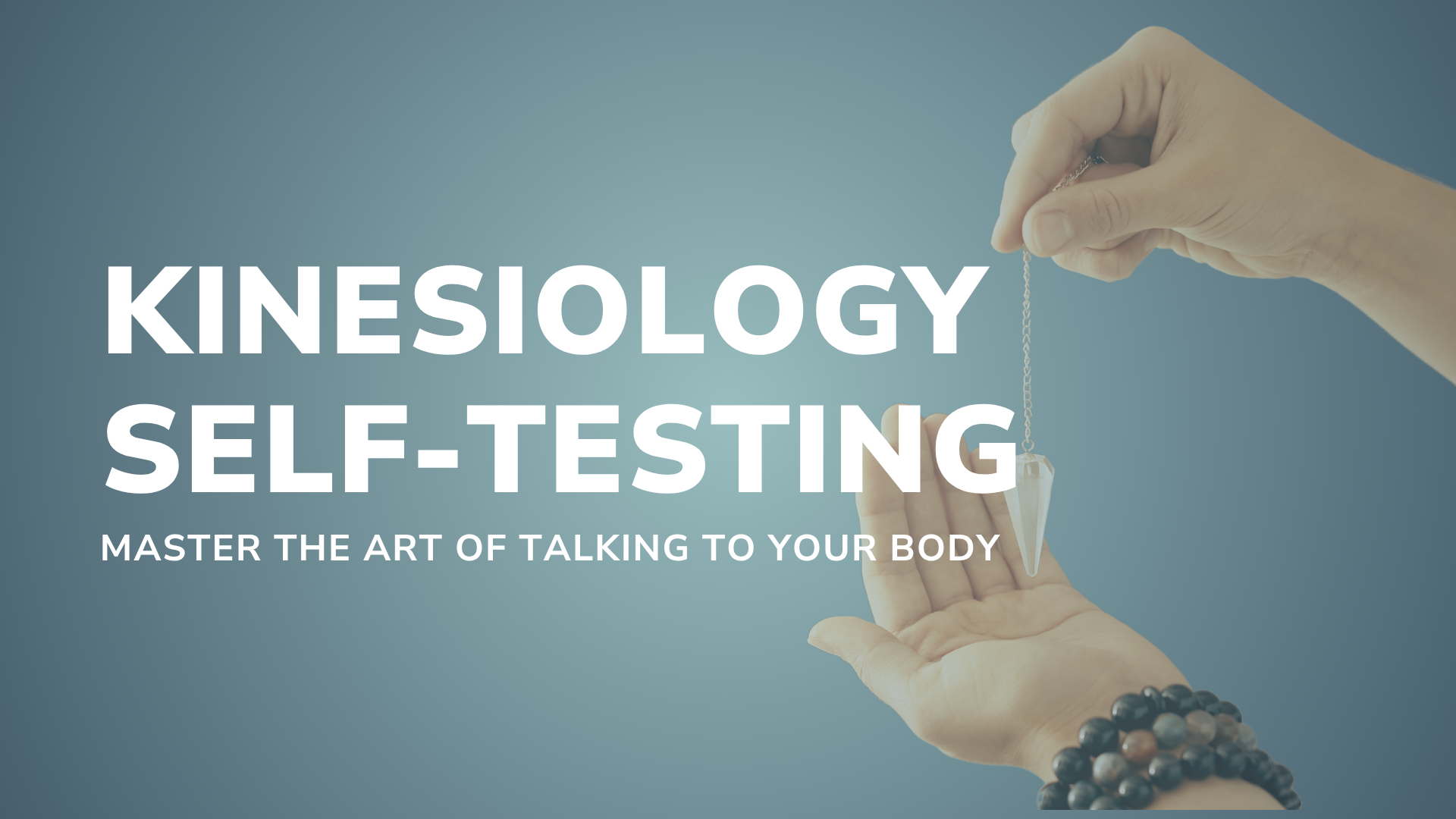
Ready to work with your body as you navigate your life?
Kinesiology Self-Testing – Master the Art of Talking to Your Body course teaches you practical self-testing skills so you can begin asking your body meaningful questions about your wellbeing, life path, and your direction.